
Fahrbericht Nordamerika
15,450 km across North America to Alaska in the CAPETRUCK
15,450 kilometers in just under ten weeks: From the port in Baltimore, the toughest test yet for my CAPETRUCK—an Iveco Daily 4×4—took me along the Trans-Canada Highway and through the Rocky Mountains all the way to Alaska. Rough gravel roads, the climb up to Sunwapta Pass, days of rain near Edmonton, and 31 °C at Dease Lake—this is where the expedition vehicle had to prove itself under real-world conditions. My honest driving report covers handling, living comfort, self-sufficiency with solar power and Starlink, as well as realistic fuel consumption figures. Breakdowns happen, too: two flat tires and a faulty jack control unit, which I repaired myself along the way.

Peter is the founder of CAPETRUCK and lives by his motto, “At home outdoors.” A former CEO of a software company and a trained mechanical engineer, he developed his own off-road expedition vehicle based on the Iveco Daily 4×4. On long trips with his dogs, Lucy and Bella, he is constantly testing and improving it.
My Road Trip Report with CAPETRUCK through the U.S., Canada, and Alaska
From the port in Baltimore all the way to Alaska: Over the past few weeks, my CAPETRUCK—an Iveco Daily 4×4 expedition vehicle—has successfully passed its most challenging test yet.
To be honest, in this report I’ll be sharing how my CAPETRUCK managed to cover about 15,000 kilometers through the U.S. and Canada all the way to Alaska. The journey took place on gravel roads, over steep mountain passes, and in temperatures ranging from freezing to sweltering. I’ll be looking at both the strengths of the vehicle and the experiences that only such a long journey can offer.
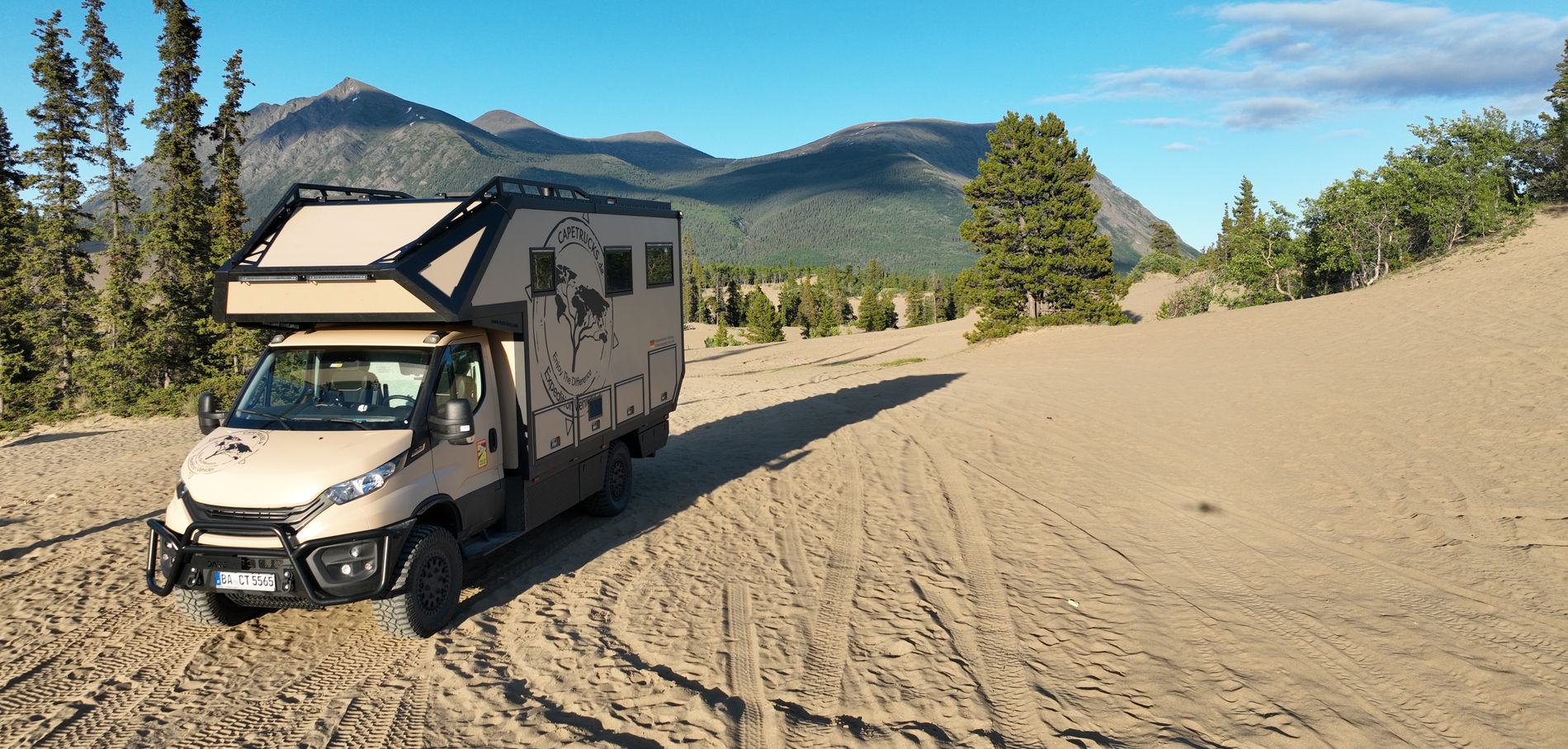
Capetruck in carcross desert, yukon
The route: from Baltimore via the Alaska Highway to Fairbanks
After it was shipped from Hamburg, I picked up my CAPETRUCK at the Port of Baltimore. My first stops were Washington, D.C., and New York. The journey then continued along the Trans-Canada Highway through Ontario, Manitoba, and Saskatchewan, led into the Rocky Mountains, and finally followed the Alaska Highway through the Yukon to Alaska. After 15,450 kilometers, it was clear: This tour presented a completely different challenge than the trip to Turkey the previous year—longer distances, different road conditions, and significantly more extreme weather conditions. Every expedition vehicle has to prove itself here in real-world conditions.
In Turkey, narrow mountain roads and gravel roads were the norm. In North America, however, additional challenges arose: extremely long highway stretches, changing road conditions, days of rain near Edmonton, heat at Dease Lake, and frosty nights in the mountains. This variety demonstrated just how versatile an Iveco expedition vehicle can be.
Handling on gravel roads, potholes, and bumps
On the gravel roads of Canada and Alaska, the CAPETRUCK handles surprisingly well over long distances—almost as if it were asphalt. But even an off-road suspension can’t handle everything; on roads with many potholes or bumps, especially at railroad crossings or bridge thresholds, it reaches its limits. Any vehicle in this class is pushed to its limits under such conditions, but the CAPETRUCK remains reliable even then—even if comfort suffers.
Compared to conventional RVs—the “white goods” from North America—the CAPETRUCK offers significant advantages. On off-road access roads like the steep, unpaved Rabbit Road near Carcross, conventional RVs would have gotten stuck, while my vehicle made it to its destination without any problems—that was a real advantage on this trip.
Icefield Parkway and Sunwapta Pass: Engine and Transmission Pushed to the Limit
The climb up the Icefield Parkway to Sunwapta Pass, which rises to 2,035 meters (a 400-meter elevation gain in one go), was a real challenge. Thanks to the reliable and precise shifting of the HI-Drive automatic transmission, the climb was smooth and controlled, even with the vehicle’s weight. With a weight of 7 to 7.5 metric tons, the engine is really put to the test; additional power reserves would be desirable for future models. Despite the standard 175–180 PS and an adjusted driving style, I made steady progress.
In situations where the engine is put to the test, the high ground clearance really comes into its own – such as on muddy tracks after rain in Edmonton or Fairbanks. So far, we haven’t needed to use the differential locks; simply knowing that we can use them if necessary gives us a sense of security.
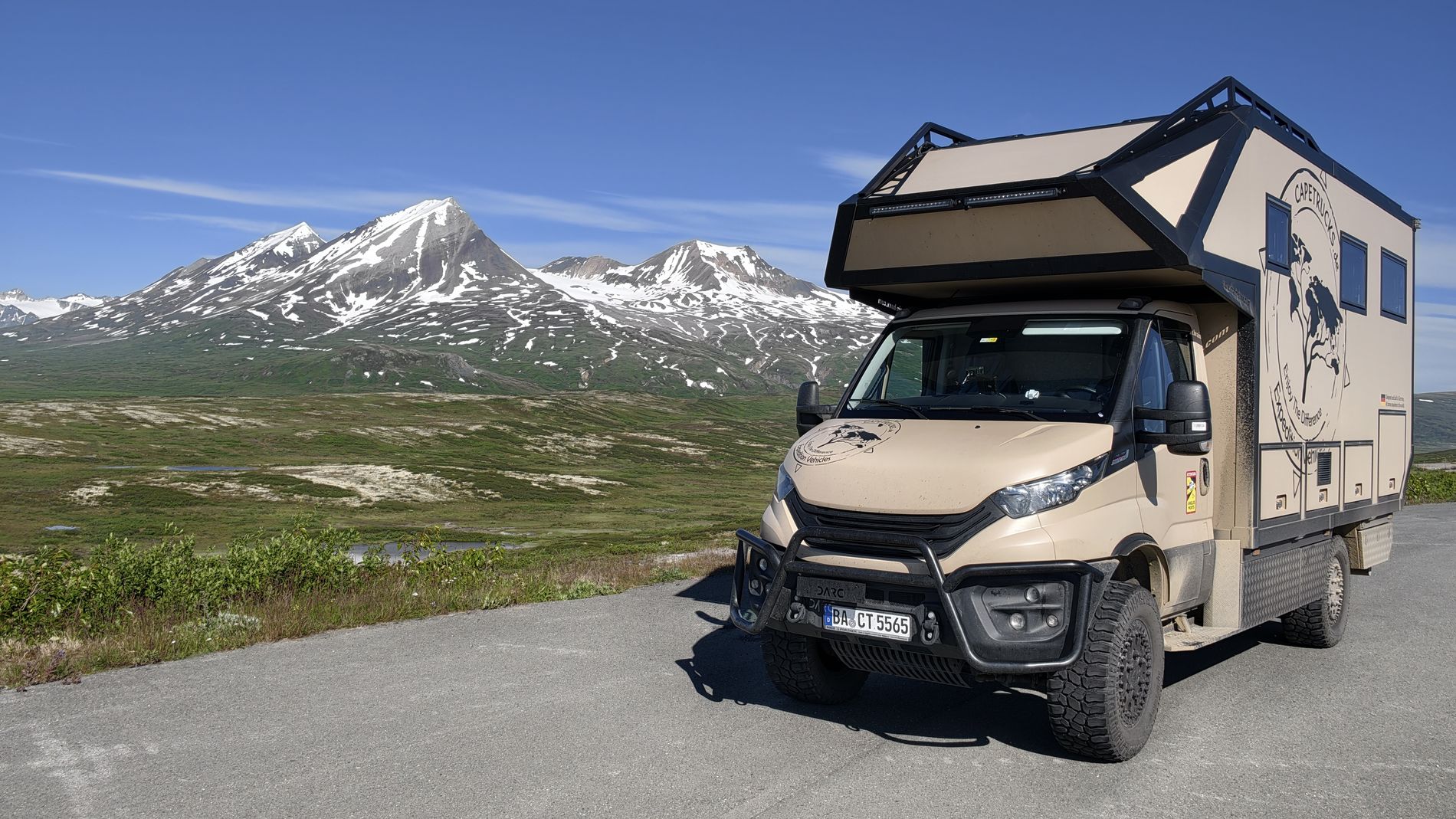
Canada, British Columbia – Haines Highway – Hight 1000 m
Tyres and suspension: Two incidents on uneven terrain
The Mileking MudChamp MK869 tires are installed and are performing well off-road, even though there are no comparable figures. Over approximately 15,000 kilometers of challenging terrain, there were only two tire incidents: The first failure, just before Edmonton, was due to a manufacturing defect; the second occurred on the Haines Highway, caused by a high axle load (approximately 4.3 metric tons on a 4-metric-ton load capacity) and difficult road conditions.
Please note: Gravel in Canada and Alaska often consists of sharp-edged, broken stones – a particular challenge for any vehicle. The fact that there were only two incidents is a testament to the robustness of the vehicle and tyre combination. Carrying out repairs whilst on the road is a demanding task and requires 4x4-offroad-tool-kit – this is an important consideration when planning routes far from major cities.
Cabin & living comfort: between cold and heat
The cabin’s insulation is well designed: even though the outside temperature was below 10 °C, it was pleasantly warm inside (17 °C) – and that was down solely to body heat, without any heating. In high temperatures (around 31 °C at Dease Lake), the interior heats up mainly through the windows, although this happens much more slowly with the blinds closed. The air conditioning was used twice and cooled the cabin reliably. The soundproofing works superbly: even days of rain in Edmonton didn’t disturb my sleep, whilst other campers were complaining about it.
There was always plenty of space – even with two dogs. I didn’t need to use the passageway between the driver’s cab and the passenger compartment – which is often used in Turkey – at all this time – a sign of just how practical the vehicle is for everyday use.
Self-sufficiency in the wilderness: solar power, electricity and Starlink
This trip has clearly demonstrated just how self-sufficient you can be whilst travelling. In around ten weeks, I only stayed at campsites twice, for two nights each time. I didn’t need to draw electricity from an external source, and fresh water was usually easy to find. Only waste water disposal poses a challenge due to differing connections – but this can be solved with the right adapter. After several days in partial shade without any movement, the solar charge level dropped to 40 %, but it could be reliably recharged using the engine (approx. 10 % per hour).
Thanks to Starlink, it was possible to stay connected whilst on the move, particularly in northern Canada, where there is often no mobile network. Although performance varied depending on the location, the system was a huge advantage. For an expedition vehicle weighing up to 7.5 tonnes, this means that travel comfort is maintained even without a connection to the road network.
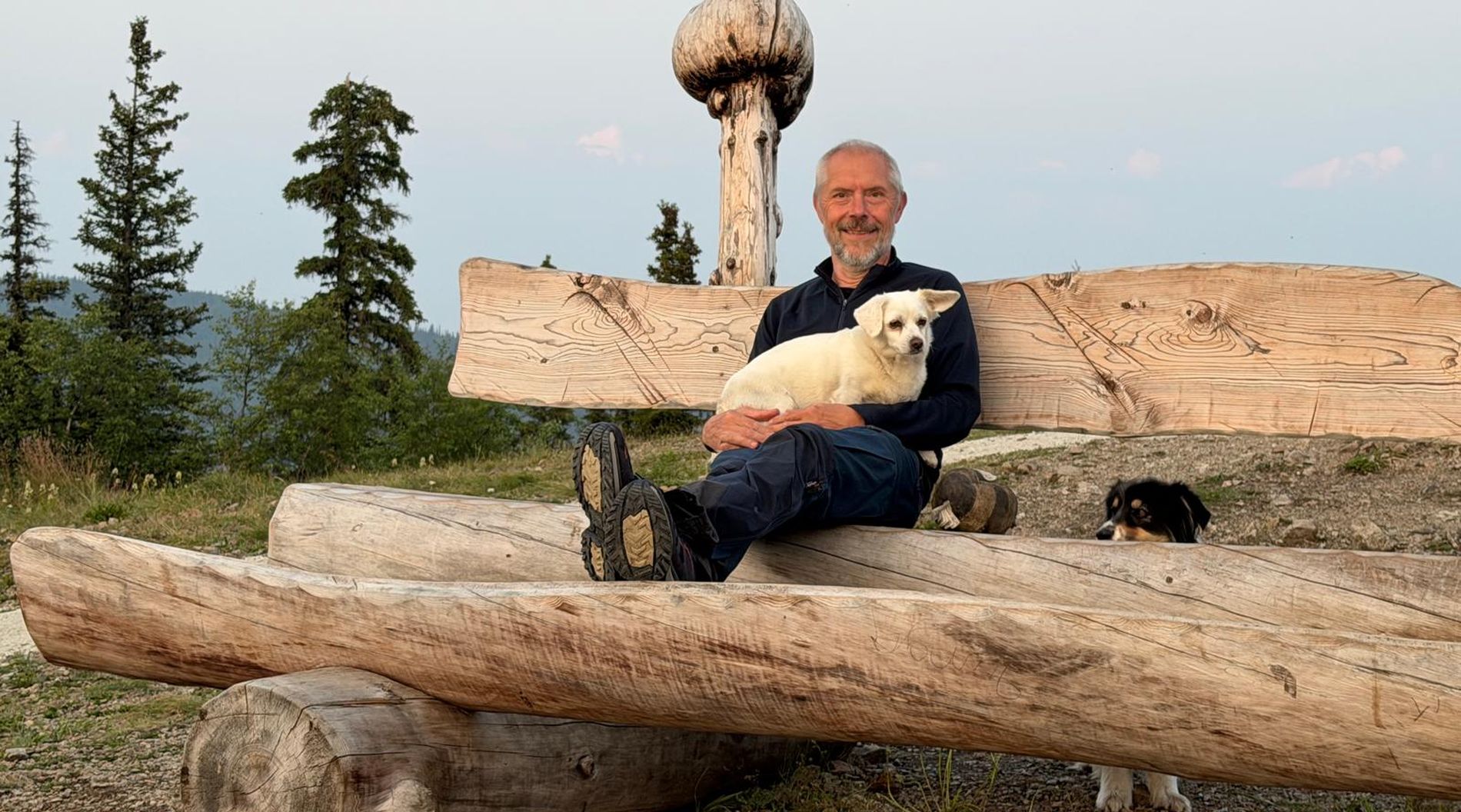
Canada – Midnight Dome – Me and my dogs
Breakdowns on the road: faulty jack stands and flat tyres
The difficulties are also part of an honest test drive report. One morning, by a Canadian lake, the levelling jacks failed – the hydraulic system’s control unit was faulty. Rather than waiting weeks for spare parts, I built a bypass control system using components I could find locally. With its robust standard technology, the vehicle is very easy to repair.
Apart from that and the two tyre incidents, no further repairs were needed – which is an outstanding result for 15,450 kilometres across rough terrain and in extreme weather. Thanks to technical know-how and a bit of improvisation, the CAPETRUCK remains fully operational even off the beaten track.
Access and the driver’s cab in everyday use
The specially developed CAPETRUCK steps have clearly proved their worth with two dogs – in comparison to the standard steps on the Iveco Daily, which are less suitable for dogs. Comfort in the cab is also impressive on long journeys; background noise is minimal, and the initial whistling sound from the transfer box almost becomes a familiar sound over time. The cruising speed is leisurely: thanks to the engine and the speed limiter set at around 90 km/h, the average speed is usually 80 km/h – ideal for a relaxed 500 kilometres a day.
Iveco Daily 4x4 fuel consumption: 24 litres of diesel per 100 km
Over the course of the journey, an average diesel consumption of 24 litres per 100 kilometres was recorded. On flat terrain (such as in Manitoba), it reached figures of 20–21 litres. AdBlue consumption was around 20 litres over 2,500 kilometres and increased noticeably when travelling at high altitudes. These are realistic figures that can be used when planning a fully fitted-out Iveco Daily 4×4 expedition vehicle.
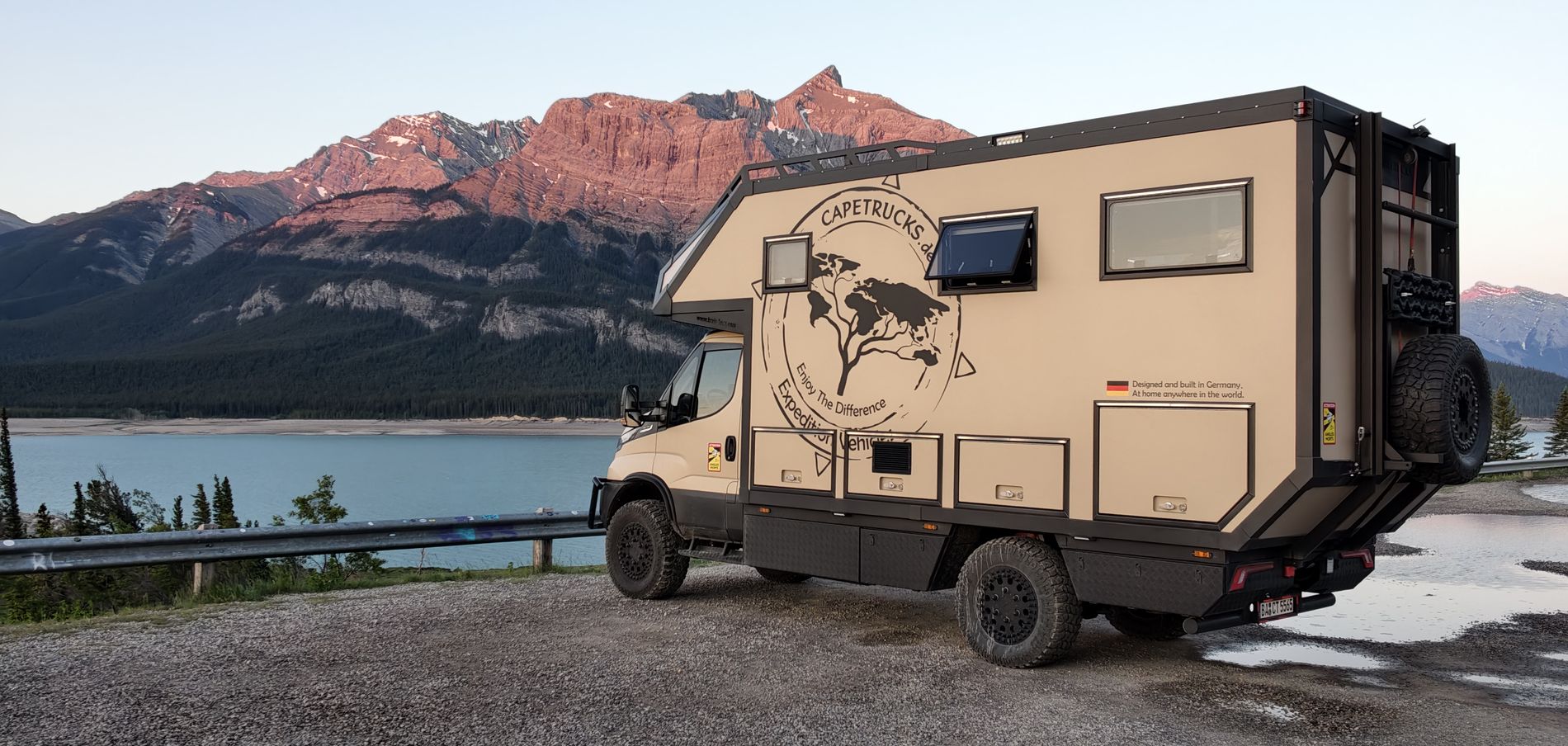
On the way to Banff National Park
Conclusion after ten weeks: Is the CAPETRUCK suitable for long-distance journeys?
Many of the insights gained from the trip to Turkey have proved true: the engine is a bit underpowered for the vehicle’s weight, but the torque is impressive, and a petrol engine might well be an interesting option. The vehicle generally copes well with uneven terrain, provided it isn’t plagued by endless potholes. As the high cab tends to sway, air suspension is planned as the next step.
However, it’s important to note: After nearly ten weeks under sometimes extreme conditions—cold, wet weather, long distances, remote locations—I can confirm that life in the CAPETRUCK works exceptionally well. The cab offers plenty of space, comfort, a pleasant interior climate, and ample storage space, even under difficult conditions. Over 15,000 kilometers, I had only two tire issues and one electronic malfunction, which I was able to fix myself. There are always technical improvements, and they’re integrated directly into the ongoing development of the production vehicles. Because there’s always room for improvement, I take these long trips to develop a vehicle that every CAPETRUCK buyer will enjoy for a long time.
Weiter zum Test drive report: Turkey …
Curious?
Request further information about the CAPETRUCK here without any obligation. I look forward to hearing from you.
The data you provide will only be processed to handle your request. More on this in our Privacy Policy.